
How to Read Psalm 23 The Right Way
When you do, it changes your entire perspective.

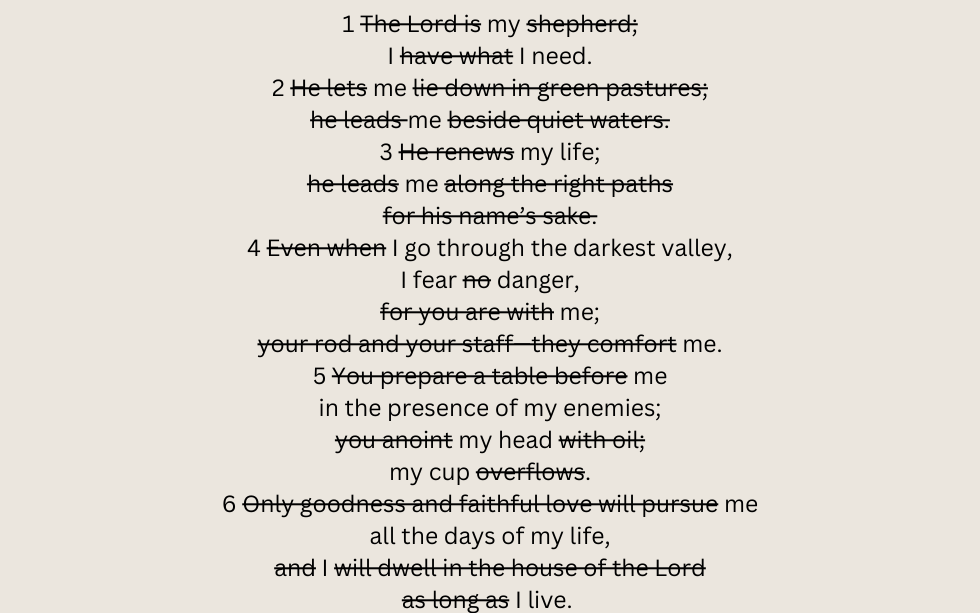
Last Friday my sister Esther shared a great post on Psalm 23, and I thought I'd add my two cents on this Labor Day morning.
One ancient Christian practice is Lectio Divina (divine reading), which involves reading a passage of scripture slowly and attentively, meditating on its meaning, praying in response, and then entering a contemplative state to listen for any insights or guidance from God. If you’ve never tried this practice, Psalm 23 is a great place to start.
As we read this passage slowly, we notice the focus is less on us and more on God as our Shepherd. It’s not a self-help passage meant to comfort us when we’re feeling down. It’s a grand invitation to lean into the total sufficiency of God, our good shepherd. Unfortunately, as Paul Miller notes, “Our modern, secular world has removed the Shepherd from Psalm 23,”[1] and this causes us to read Psalm 23 like the image posted above.
Everything is about us.
The Mindset of a Sheep
But everything changes when we read Psalm 23 through the shepherd's perspective. In A Shepherd Looks at Psalm 23 (A book I noticed Esther referenced), Phillip Keller provides valuable first-hand insight into sheep's connection with their shepherd.
“Sheep do not ‘just take care of themselves,’ as some might suppose,” Keller writes, “They require, more than any other class of livestock, endless attention and meticulous care.”[2] He goes on to say, “It is no accident that God has chosen to call us sheep. The behavior of sheep and human beings is similar in many ways.”[3]
Sheep and humans like to think of themselves as independent without needing direction. As Keller points out, “A commonly held but serious misconception about sheep is that they can just ‘get along anywhere.’ The truth is quite the reverse. No other class of livestock requires more careful handling, more detailed direction, than do sheep.”[4] The same is true for humans. We like to think we’re in total control of our destiny when the truth is we are entirely dependent on the goodness of God.
It's easy to use Psalm 23 as a cry for God’s help when what we really need is his presence. Psalm 23 teaches us that when we have the good shepherd, we have everything we need. As Keller says,
It is the sheep owner’s presence that guarantees there will be no lack of any sort; there will be abundant green pastures; there will be still, clean waters; there will be new paths into fresh fields; there will be safe summers on the high tablelands; there will be freedom from fear; there will be antidotes for flies and disease and parasites; there will be quietness and contentment.[5]
Psalm 23 teaches us to refocus our attention. While we’re naturally inclined to focus on the stresses of life, problematic relationships, and everything we lack, the good shepherd helps us see that when we have him, we have everything we need.
In Life Without Lack: Living in the Fullness of Psalm 23, Dallas Willard says, “One of the fundamental changes that takes place as we move from the faith of desperation to the faith of sufficiency is that we take our minds off ourselves and place them on God.”[6]
The Good Shepherd
When we read both Psalm 22 and Psalm 23 through the lens of Jesus, these passages take on added significance. Jesus quotes from Psalm 22:1 when he is on the cross and asks, “My God, my God, why have you abandoned me?” But in John 10:11-15, Jesus shows that he is the good shepherd when he says:
11 “I am the good shepherd. The good shepherd lays down his life for the sheep. 12 The hired hand, since he is not the shepherd and doesn’t own the sheep, leaves them and runs away when he sees a wolf coming. The wolf then snatches and scatters them. 13 This happens because he is a hired hand and doesn’t care about the sheep. 14 “I am the good shepherd. I know my own, and my own know me, 15 just as the Father knows me, and I know the Father. I lay down my life for the sheep.
In Mark 6:34, Jesus lives this out. It says, “When he went ashore, he saw a large crowd and had compassion on them, because they were like sheep without a shepherd. Then he began to teach them many things.” Notice what else he does. He invites them to sit on the green grass and feeds them – just as any good shepherd would.
In reality, every human is, by nature, a rebellious sheep. As Isaiah 53:6 says, “We all went astray like sheep; we all have turned to our own way; and the Lord has punished him for the iniquity of us all.” But Psalm 23 teaches us that when we have the good shepherd, when we have Jesus, we have everything we need.
[1] Miller, Paul E.. A Praying Life: Connecting with God in a Distracting World (p. 74). The Navigators. Kindle Edition.
[2] Keller, W. Phillip. A Shepherd Looks at Psalm 23 (p. 7). Zondervan. Kindle Edition.
[3] Keller, W. Phillip. A Shepherd Looks at Psalm 23 (p. 7). Zondervan. Kindle Edition.
[4] Keller, W. Phillip. A Shepherd Looks at Psalm 23 (p. 58). Zondervan. Kindle Edition.
[5] Keller, W. Phillip. A Shepherd Looks at Psalm 23 (p. 130). Zondervan. Kindle Edition.
[6] Willard, Dallas. Life Without Lack (pp. 112-113). Zondervan. Kindle Edition.