
Why Is Maundy Thursday Important?
Why is the Lord's Supper so important? And what meaning does it hold for my life? Here are a few thoughts.

Have you ever felt unqualified to be a Christian?
Maybe you feel embarrassed over all the times you’ve let God down. Gradually, the more you obsess over your failures, the harder you find it to spend time with God. You convince yourself he wouldn’t want to be close to someone like you.
If this is your story, Matthew 26 is for you on this "Maundy Thursday." If you're unfamiliar with this term, Maundy Thursday commemorates the night of the Last Supper, when Jesus Christ shared a final meal with his disciples before his crucifixion. The word “Maundy” comes from the Latin mandatum, meaning “command,” referring to Jesus’ instruction to “love one another as I have loved you.”
As Jesus prepares for his last supper with his disciples, excitement fills the city, and emotions run high. The Passover meal followed a specific order, beginning with drinking a cup of red wine mixed with water, followed by the ceremonial washing of hands, symbolizing the need for spiritual and moral cleansing.
Bitter herbs were then eaten to represent the bondage in Egypt. After this, the second cup of wine was served, during which the head of the household explained the significance of Passover. They would then sing the first two psalms of the Hallel (Psalms 113-118). The lamb was brought out next, with the head of the household distributing pieces of it along with unleavened bread, and finally, the meal concluded with the drinking of the third cup of wine.
“Matthew’s words suggest that, as Western art has generally assumed, only thirteen people were at the table, which would be a typical size for a Passover meal.”[1] As they ate, Matthew 26:26-30 says,
26 Jesus took bread, blessed and broke it, gave it to the disciples, and said, “Take and eat it; this is my body.” 27 Then he took a cup, and after giving thanks, he gave it to them and said, “Drink from it, all of you. 28 For this is my blood of the covenant, which is poured out for many for the forgiveness of sins. 29 But I tell you, I will not drink from this fruit of the vine from now on until that day when I drink it new with you in my Father’s kingdom.” 30 After singing a hymn, they went out to the Mount of Olives.
A New Moment
This moment marks a new covenant between God and humanity. Among those present at the table are four significant figures: John, Peter, Thomas, and Judas. Each was very different and had differing levels of closeness to Jesus.
John, known as the “beloved disciple,” experienced three pivotal moments of closeness with Jesus. He was one of the few chosen to witness the raising of Jairus’ daughter, the Transfiguration, and Jesus’ agony in the Garden of Gethsemane.
Peter, always bold and passionate, had moments of both great faith and profound failure. Though he promised never to deny Jesus, fear would overtake him, causing him to deny Jesus three times. But Jesus, in his grace, would restore Peter, giving him the chance to reaffirm his love.
Thomas was a doubter who would one day need to see the nail prints in Jesus’ hands to believe he had risen from the dead. And Judas would betray Jesus for thirty pieces of silver.
Despite their wide background and lack of qualifications, Jesus invited these four very different people to sit at the table, eat of his body, and drink of his blood.
An Invitation to All
This scene in Matthew 26 reminds us that Jesus’ invitation is extended to all, no matter our flaws, doubts, or past regrets. Each disciple’s journey revealed a unique aspect of Jesus’ love and the transformative power of his grace.
- Through John, we see a Jesus who longs to draw us close.
- Through Peter, we see a Jesus who loves us despite our insecurities.
- Through Thomas, we see a Jesus who loves even those who struggle to believe.
- And through Judas, we see a Jesus who extends his hand even to those who will betray him.
Which one of these four portraits do you resonate with the most? Regardless of your answer, you can take confidence in serving a God who loves you where you are. He has graciously invited you to have a seat at the table.
Here’s why this is significant. It’s tempting to approach Christ based on the merits of what we’ve accomplished. But when we do this, we will either overinflate our position or devalue our eternal worth. Both positions lead to despair. However, everything changes when we approach the table, drink Christ’s blood, and eat his broken body as recipients of extraordinary grace.
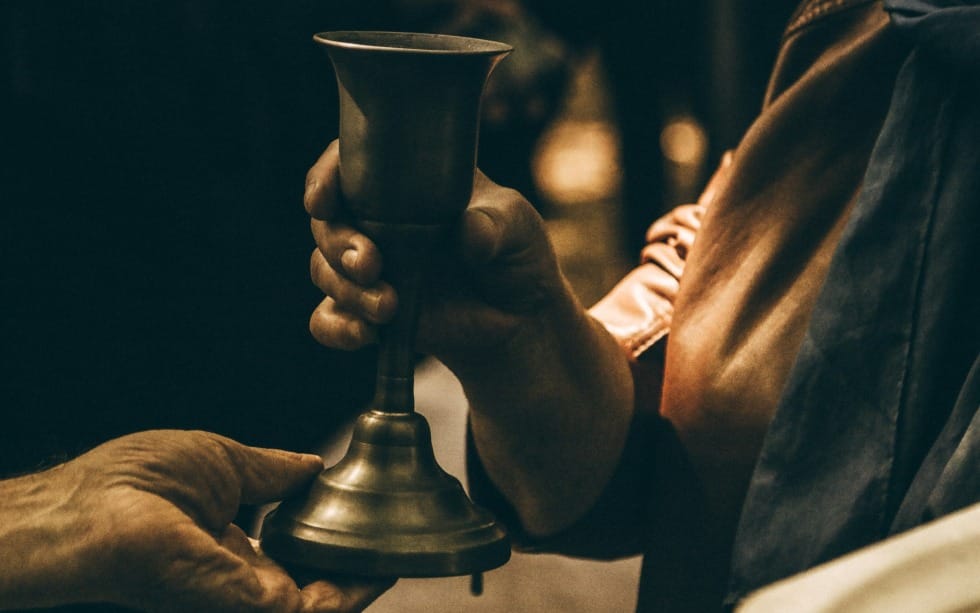
This is something to remember when you attend a service this weekend, and your pastor invites you to take part in communion. When he says, “Eat of this bread” and “Drink of this wine” in remembrance of what Christ has done, this is not a mere formality. It’s a tremendous reminder that even people like you are invited to the table.
You do not serve a God who is aloof and holds you at arm’s length. You serve someone who wants to pull you close.
[1]R. T. France, The Gospel of Matthew, New International Commentary on the New Testament. Accordance electronic ed. (Grand Rapids: Eerdmans, 2007), 989.