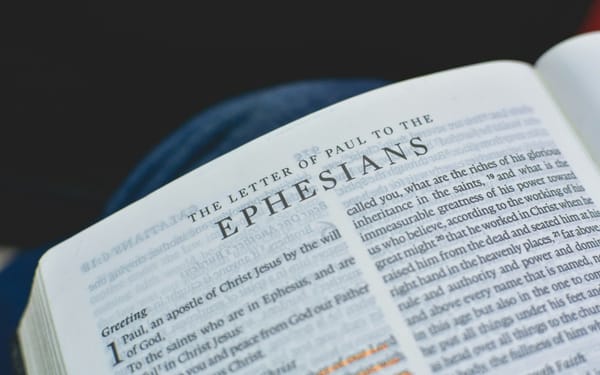
What God's Law Was Never Intended to Do
Do you have a hard time making sense of God's law and how it applies to you today? You're not alone, but here are some thoughts to consider.


Have you ever read the Old Testament and thought to yourself, why did God give so many laws, and how do they apply to me today?
In Deuteronomy 14-25, for example, we read a list of laws that includes regulations on tithing, guidelines for the treatment of slaves, rules related to agricultural practices, provisions for debt relief, laws regarding charitable practices, inheritance rights, and the punishment for false witnesses in legal proceedings.
The purpose of these laws was to give God's people a physical demonstration of holiness, which was a separation of all that was common and ordinary. But this raises the question: How do these laws apply to us today? Tim Mackie says,
The laws are part of one unified story that demonstrates God’s character, wisdom, and the pitfalls of human nature. Just because a law wasn’t quoted in the New Testament doesn’t mean it’s without value. We can find wisdom for our contemporary context in all of the laws.[1]
Some have organized the laws into three categories: Moral, ceremonial, and civil. My college professor, Alan Brown, created what he called the UP/SA principle: Universal Principle or Specific Application. This means that some laws are binding on all humans throughout history, while others were only given to a specific people group at a specific time.
The Great Law Misconception
When Paul wrote Galatians, one of the great challenges he faced was a people who were persuaded that obedience to the Mosaic law, especially markers like circumcision and food laws, was required for full acceptance by God.
The law became a way to secure identity, belonging, and righteousness rather than revealing sin and pointing them to Christ.
As a result, they treated the law not as a tutor that led them to faith, but as a system to return to after faith, blending grace with performance and turning the gospel into a conditional, works-based path to approval. This prompted Paul to write in Galatians 2:17-20:
17 But if we ourselves are also found to be “sinners” while seeking to be justified by Christ, is Christ then a promoter of sin? Absolutely not! 18 If I rebuild those things that I tore down, I show myself to be a lawbreaker. 19 For through the law I died to the law, so that I might live for God.
Notice what Paul does.
He tears down the idea that the law could make him righteous. If he now goes back and tries to rebuild that system, he proves that the law never worked in the first place and that he’s the one at fault, not Christ. The failure isn’t in the gospel; it’s in trying to mix the gospel with a system that already condemned him.
Then Paul says something radical: “Through the law I died to the law.” The law did its job by showing him that he could never live up to it. It drove him to the end of self-effort. In that sense, the law killed him. But that death had a purpose: “so that I might live for God.”
A Grand Pivot
Verse 20 is the heart of it all, and Paul says, "I have been crucified with Christ, and I no longer live, but Christ lives in me. The life I now live in the body, I live by faith in the Son of God, who loved me and gave himself for me."
Paul sees his old identity as finished. The version of him that tried to prove himself, justify himself, and save himself through performance is dead. He doesn’t say he improved it or disciplined it. He says it died.
His life is now sourced from Christ, not from law-keeping or self-effort. When he says, “The life I now live in the body, I live by faith,” he’s saying everyday life is now lived by trust, dependence, and relationship, not by fear of failure or rule compliance.
The law showed Paul he was dead. Christ gave him a new life. In Matthew 5:17, Jesus shows how he viewed the Law when he said, “Don’t think that I came to abolish the Law or the Prophets. I did not come to abolish but to fulfill." He adds in verse 20, "For I tell you, unless your righteousness surpasses that of the scribes and Pharisees, you will never get into the kingdom of heaven."
That verse is especially poignant because it tells us how insufficient rule-keeping is. While many see following Jesus as a list of dos and don’ts, Jesus showed that it was much more than that. R.T. France writes,
Those who are to belong to God’s new realm must move beyond literal observance of rules, however good and scriptural, to a new consciousness of what it means to please God, one which penetrates beneath the surface level of rules to be obeyed to a more radical openness to knowing and doing the underlying will of ‘your Father in heaven.’[2]
So What Does This Mean?
Here's why this is so important.
If you view God's laws as rules to be obeyed that give you closer access to him, each time you go to read God's Word, you'll feel like you're adding one more burden you're not equipped to bear. You'll feel crushed.
This is why it's imperative to understand the true purpose. The purpose of God's law is to reveal the sin in your heart. It was never intended to save you. So stop treating it like it can.
Instead, be like Paul and trust in the full sufficiency of Christ's saving work, recognizing that there is nothing you can do to earn your salvation. Then, as you fully embrace this free gift, let your love and gratitude for God motivate you to love and obey the universal principles of his law and learn from the specific applications.
[1] “Which Laws Still Apply?” The Bible Project, accessed January 20, 2024, https://bibleproject.com/podcast/which-laws-still-apply/#:~:text=The%20laws%20are%20part%20of,the%20pitfalls%20of%20human%20nature.
[2]R. T. France, The Gospel of Matthew, New International Commentary on the New Testament. Accordance electronic ed. (Grand Rapids: Eerdmans, 2007), 190.