
The One Commandment My Generation Finds Easiest to Ignore
Do you have a hard time honoring your parents? If so, here are some thoughts to consider.

Do you have a good relationship with your parents?
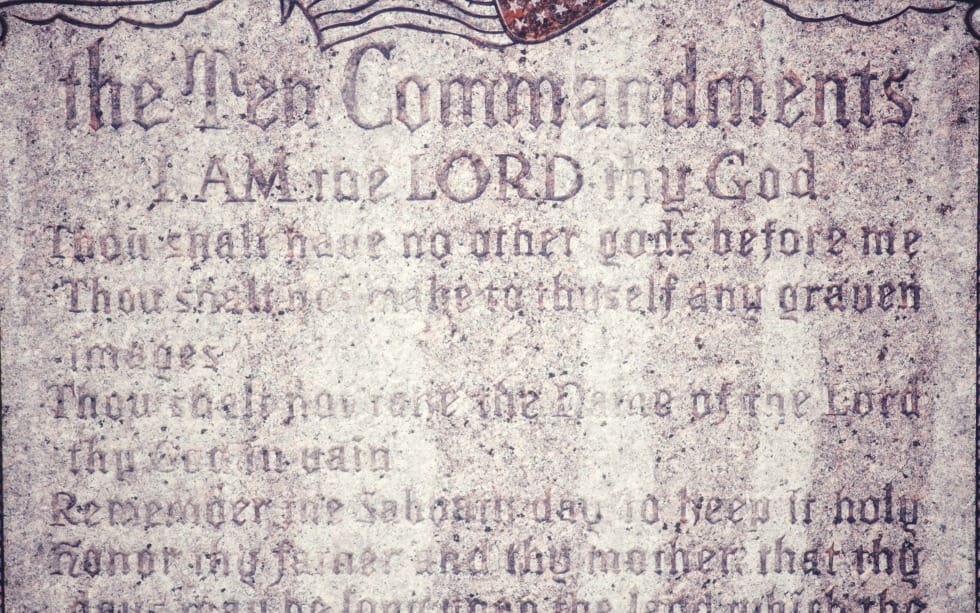
I know, I know. That’s a personal question for a Monday, but it’s one I’ll ask anyway because it’s a topic Scripture addresses on several occasions. In Exodus 20:12, God commands his people to honor their parents.
But what does that even mean?
Family dynamics can be tricky, and according to YouGov, 38% of American adults say they are currently estranged from a sibling (24%), a parent (16%), a child (10%), a grandparent (9%), or a grandchild (6%).
With the sharp political divide in our culture, it’s not uncommon to hear someone say, “Oh, I just don’t talk to that family member anymore.”
Maybe you find yourself in this category with a parent. Relational dynamics can be tricky, and there’s a bit of a generational divide when it comes to repairing relationships between children and adults. Older generations tend to err on the side of charity that overlooks abuse, while younger generations tend to lean toward psychologically based individualism that dismisses the depths of God's love.
Still, to both groups, Paul's words in Ephesians 6:1-4 have profound meaning:
1 Children, obey your parents in the Lord, because this is right. 2 Honor your father and mother, which is the first commandment with a promise, 3 so that it may go well with you and that you may have a long life in the land. 4 Fathers, don’t stir up anger in your children, but bring them up in the training and instruction of the Lord.
The Reason For Honor
Note that Paul is quoting from The Ten Commandments given in Exodus 20, and the word he uses for “honor” means to value, to treat as weighty, and to assign worth. He’s not saying to agree with parents or think they’re wonderful people. But he does call on us to honor them.
Why should we do this? In verse 3, quoting from Exodus 20:12, Paul says, “so that it may go well with you and that you may have a long life in the land.”
This tells us the command to honor our parents isn’t just for their well-being. It’s for our sake and the sake of the broader community. As Klyne Snodgrass writes, “God’s promise is based on the presumption that obedience to parents leads to order and stability.”[1]
God isn’t saying, “Honor your parents, and you’ll live to be 150.” Instead, he’s saying that doing so will be the best for your life, your kids, and those around you. As Francis Foulkes notes, “When the bonds of family life break up, when respect for parents fails, the community becomes decadent and will not live long.”[2]
How Do I Honor When I Have Strong Disagreements?
I’m not going to pretend this is easy, and I’ll give you an example. While my relationships with my mom and in-laws are wonderful, my relationship with my dad is a different story, and we haven't spoken in years.
This doesn’t make me happy, but it’s a reality. Unfortunately, for the past two decades, Dad has made it clear that he wants little to do with his kids and has told me repeatedly that the best years of his life were after his family was gone.
Even today, when he visits my siblings, he’ll tell them in advance he’s only staying for a couple of hours, and then he’ll be gone. Do I think this is right? No, but I am still called to honor him.
So what does that mean? Again, this gets a bit tricky, but there are two ways I apply Ephesians 6 to my life: one external and one internal.
From an internal perspective, I refuse to harbor any feelings of anger or bitterness against my dad. This took a few years, and occasionally, it’s a choice I still need to make. Some days I’ll have a little pity party and think of some of the things I missed out on in not having a dad, but then I talk to God, and let it go. And today, I can honestly say I want nothing but the best for him.
From an external perspective, I’ve worked hard to scale back my public criticisms. Even in this post, I deleted a few paragraphs that might have better "set the scene" and added some emotion, but might have been overly disparaging. Because, regardless of my experiences, he is still my dad and someone to be honored.
And regardless of what he has done to me and those I love, I want to sow good seeds today that take root in my kids tomorrow. Seeds of honor and respect that I hope will have a ripple effect in my little community.
Be Careful About Cutting Someone Off
Honoring your parents can be challenging. Perhaps you’re in a position like mine, where you have a parent who has little desire for the relationship to improve. If so, all I can tell you to do is keep praying that something changes and listen to the Holy Spirit for ways you can play a part in their lives.
But if you’re at odds with a parent who loves you, this is where I’d challenge you to ask a tough question. Ask yourself if the distance you’ve created is a necessary decision or a separation of convenience.
This is where it gets tricky. On one end of the spectrum, I’ve talked to children who have suffered horrendous abuse and had to create a barrier between themselves and their abusers. On the other hand, I’ve spoken with some who simply saw life differently and felt that their parents were no longer aligned with their values.
If you’re estranged from a family member, a simple question to ask is, “Does this family member genuinely love me? Not “do they vote the same way I vote?” not “do they support ideas I think are harmful?” but “are they someone who would stay by my bedside if I became terminally ill with cancer?”
If the answer is yes, I’d think long and hard before cutting them off.
I’ve noticed it’s easy for children in their twenties and thirties, when life is good and their families are growing, to discard their imperfect parents, sending them to their graves in agony as they watch the very children they sacrificed everything for turn their backs on them.
Again, I don’t know your situation, but life only gives you so many people who will love you enough to sit with you when you have nothing to offer. Don’t treat these relationships lightly, because there might come a day when you will need them more than you think. Instead, invest in ways that might seem hard now, but that set a pattern for your children to follow when they wake up one day to recognize their own imperfect parent.
Do everything you can to extend honor and grace—the same kind of grace Christ has extended to you time and time again. A grace that is stronger than what your psychologist might recommend, richer than what your closest friends suggest, and more loving than you feel capable of in your own strength.
[1]Klyne Snodgrass, Ephesians, eds. Terry C. Muck, The NIV Application Commentary. Accordance electronic ed. (Grand Rapids: Zondervan, 1996), 322.
[2]Francis Foulkes, Ephesians: An Introduction and Commentary, vol. 10 of Tyndale New Testament Commentaries. IVP/Accordance electronic ed. (Downers Grove: InterVarsity Press, 1989), 169.