It All Comes Back to Grace Through Faith
Faith reveals your true source of trust. Do you really take God at his word and trust him without reservation, or do you always insert yourself as the safety net?

Have you ever wondered what your life would look like apart from the grace of God? When I was a kid, I listened to a singer named Larnelle Harris, and etched in my memory are these words from his song "Were It Not for Grace." The chorus goes:
Were it not for grace
I can't tell you where I'd be
Wandering down some pointless road to nowhere
With my salvation up to me
I know how that would go
The battles I would face
Forever running but losing the race
Were it not for grace
Romans 3 gives us a picture of our need for grace. In step-by-step progression, Paul shows us several important points.
The first point is that our background does us little good.
In verse 9, he says, “both Jews and Greeks are all under sin.” Our heritage or upbringing does not give us special standing before God.
No matter where we come from, we all fall under the same judgment of sin. It’s a reminder that God's grace is not based on who we are or what we’ve done; it’s based solely on his love and mercy.
Second, our desire to do right is nonexistent without grace.
In verses 10-18, Paul paints a vivid picture of life apart from God’s grace, quoting several Old Testament passages to illustrate that without God’s intervention, our hearts are naturally inclined away from righteousness. It doesn’t matter how much we try to be "good" on our own. Without grace, our efforts are empty.
This reality can be difficult to accept, especially when we’ve placed our trust in our own moral efforts. But recognizing our inability to be righteous without God opens the door to a deeper, more genuine faith. It pushes us to surrender our self-reliance and lean fully into His grace.
Third, our “good actions” will never be enough.
Verse 20 says, “For no one will be justified in his sight by the works of the law.” Adhering to rules or trying to live a “good life” will not save us.
The Law, as Paul points out, was never meant to justify us but rather to reveal our need for a Savior. The Law acts like a mirror, showing us our shortcomings. It points out the flaws in our character and our desperate need for God’s grace. In this way, it drives us toward faith in Christ, the only one who can fulfill the Law's righteous requirements on our behalf.
Fourth, our works will always fall short.
Romans 3:23-24 states, “For all have sinned and fall short of the glory of God; they are justified freely by his grace through the redemption that is in Christ Jesus.”
No matter how much good we do, we can never measure up to God’s perfect standard. But this realization doesn’t leave us hopeless. It directs us to the hope found in Jesus. His grace fills the gap our works never could, offering us a righteousness that comes through faith, not our own merit.
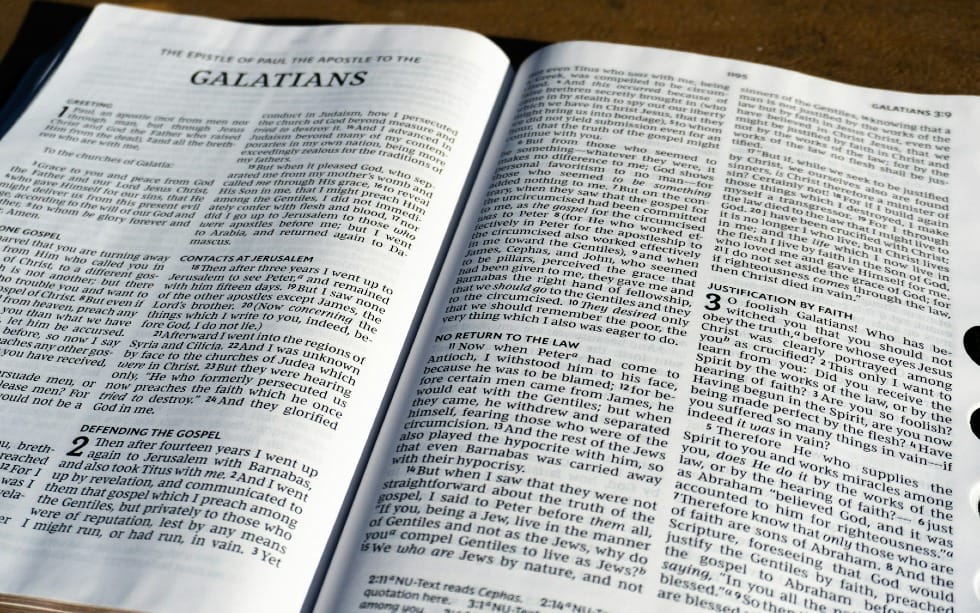
It's no wonder Paul ends his letter to the church of Galatia with these words, "Brothers and sisters, the grace of our Lord Jesus Christ be with your spirit. Amen."
Grace Through Faith
There is nothing we can do to earn God’s grace. As John Stott writes,
The first move was God the Father’s, and our justification is freely by his grace, his absolutely free and utterly undeserved favor. Grace is God loving, God stooping, God coming to the rescue, God giving himself generously in and through Jesus Christ.[1]
We are saved by grace through faith alone. In Romans 4, Paul shows that Christians are justified by faith. Like Abraham and all who have come before and since, everything comes down to faith. Why does God save his people through faith? The Life Application Study Bible lists four reasons:
“(1) Faith eliminates the pride of human effort, because faith is not a deed that we do. (2) Faith exalts what God has done, not what we do. (3) Faith admits that we can’t keep the law or measure up to God’s standards—we need help. (4) Faith is based on our relationship with God, not our performance for God.”[2]
In a world obsessed with performance, faith frees us from personal ego.
As a Christian, your natural response to God’s grace should be faith in his character and activity. Your faith should be active and dynamic. It’s a faith that follows God through good times and bad.
Faith reveals your true source of trust. Do you really take God at his word and trust him without reservation, or do you always insert yourself as the safety net?
[1]John R. W. Stott, The Message of Romans: God’s Good News for the World, The Bible Speaks Today. Accordance electronic ed. (Downers Grove.: InterVarsity Press, 2001), 112.
[2]Life Application Study Bible, Accordance electronic ed. (Carol Stream: Tyndale House Publishers, 2004), paragraph 14720.