
How Do I Respond When Others Talk About Me Behind My Back? (Ecclesiastes 7-8)
Ever been hurt by what someone said about you? Ecclesiastes reminds us to give grace, knowing we’ve spoken careless words too.

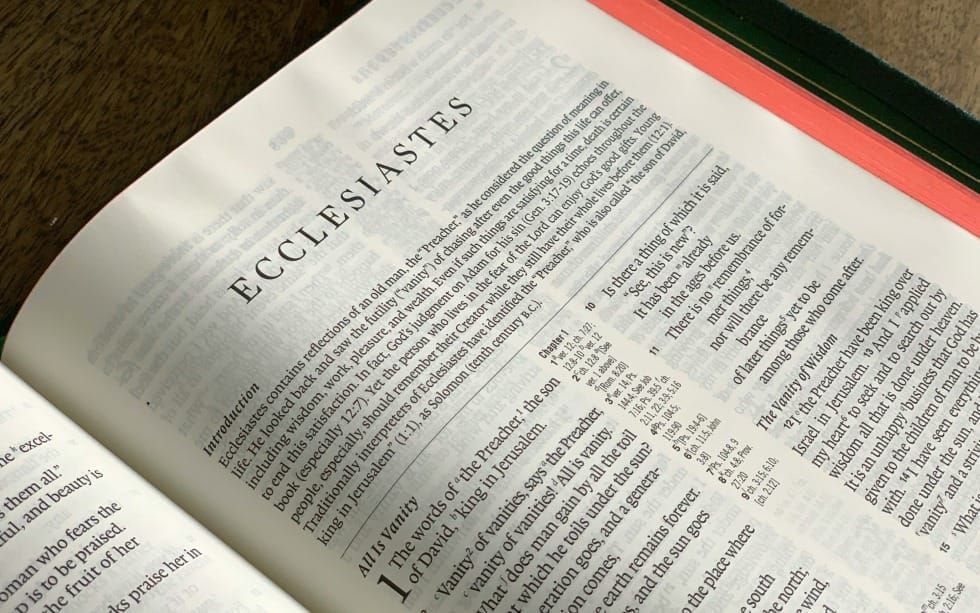
Ecclesiastes 7-8
Today's Scripture Passage
A Few Thoughts to Consider
Have you ever overheard someone say something nasty about you?
You walked by their cubicle at work, read that email you weren’t supposed to be CC’d in, or heard from someone else what your “friend” said about you. Your face flushes with anger, and you can’t wait to speak to them, say something sarcastic, or better yet, give them the cold shoulder until they fess up. If this is where you’re at today, Ecclesiastes 7:21-22 is just the passage you need.
Here, the preacher of Ecclesiastes says, 21 “Don’t pay attention to everything people say, or you may hear your servant cursing you, 22 for in your heart you know that many times you yourself have cursed others.” These verses highlight the previous verse, which says, “There is certainly no one righteous on the earth who does good and never sins.”
As Jerry Shepherd writes, these verses “call appropriate attention to the all–too-hasty reaction of condemning others for things you have done yourself, or toward which you have a tendency but perhaps lack occasion.”[1] The Hebrew word translated as “cursing” might mean “slander” or “grumble.”[2] In The Message, Eugene Peterson paraphrases this verse as “Don’t eavesdrop on the conversation of others. What if the gossip’s about you, and you’d rather not hear it?”
This is the path of a wise person. A fool always takes things personally and never gives the benefit of the doubt. A wise person takes time for introspection and realizes they, too, need grace, and if they were honest with themselves, there are times they have treated others in just the same manner.
❤️ Enjoy what you’re reading?
Consider supporting The Monday Christian. For a dollar a month, given as a simple one-time donation, you help keep this ministry free and growing for every reader.
Support TMCA Meditation to PRAY
Praise | Lord, I praise you for your wisdom, which reminds me not to take every word spoken against me to heart. You are gracious, slow to anger, and rich in compassion, guiding me to walk the path of humility. Thank you for reminding me that I, too, need grace as I fall short in my words and actions.
Release | I release my desire to retaliate when I overhear negative words spoken about me. I let go of my pride, which tempts me to take offense and hold others to standards I have not upheld myself. I surrender the bitterness that builds when I focus too much on others' criticisms.
Ask | I ask for your strength to respond with grace when I am wronged, just as you have extended grace to me. Help me look inward and see my flaws before judging others. Fill me with wisdom to know when to confront and when to let things go, trusting in your justice.
Yield | I yield to your truth that I am no better than those who wrong me, and I trust in your ability to transform my heart. I choose to walk the path of wisdom, giving grace instead of offense and trusting that you will handle all things in your perfect timing.
A Challenge to Act Like Christ
Iain Provan is right when he says, “One’s attitude to other human beings should be conditioned by the awareness of one’s own flawed humanity.”[3] Only as we realize the extent of our own selfish actions can we give grace to others. In fact, when we don’t give grace, we betray the fact that we’ve misunderstood the very nature of the gospel, where God offered his unmerited grace to those who least deserved it.
Too often, we’re incredibly self-righteous. When someone says something we think is unjust, our pride kicks in, and we feel it’s our right to be offended. However, the author of Ecclesiastes says the opposite. He’s saying it’s in the moments we are offended most that we should look inward and confront the pride in our own hearts. As Psalm 53:3 says, “There is no one who does good, not even one.”
The next time we overhear someone speak a negative word about us, this is our chance to put our faith into action and decide if we believe the whole gospel. Certainly, there are times when we should confront others. Matthew 18 has something to say about this. But there are other times we should just let things slide and stop taking ourselves too seriously.
Ask yourself, Would I want even my closest friends and family members to know every negative word I have spoken about them? Of course not. Everyone says flippant things they regret, and if you hold others to a standard to which you don’t even hold yourself, you’ll always walk around offended and betrayed.
So, walk in the paths of wisdom. “Don’t pay attention to everything people say.” Give grace as someone who is in desperate need of it yourself.
*Unless you specify otherwise, comments and questions you ask may be featured in upcoming podcast episodes.
[1]Jerry E. Shepherd, “Ecclesiastes,” in Proverbs-Isaiah, vol. 6 of The Expositor’s Bible Commentary Revised Edition. eds. Tremper Longman III and David E. Garland; Accordance electronic ed. (Grand Rapids: Zondervan, 2008), 322.
[2]Tremper Longman III, The Book of Ecclesiastes, New International Commentary on the Old Testament. Accordance electronic ed. (Grand Rapids: Eerdmans, 1998), 199.
[3]Iain Provan, Ecclesiastes, Song of Songs, The NIV Application Commentary. Accordance electronic ed. (Grand Rapids: Zondervan, 2001), 153.