A Thought That Leads to Despair
How Fresh Wind, Fresh Fire shaped me as a teenager.

Throughout the month of May, I’ve asked our TMC writers to share a few thoughts on great books that have shaped them at a pivotal moment in their lives. As a book junkie, I’ve enjoyed reading what they have written, and several of you have reached out to express your thanks.
It's interesting how different book styles affect us in different ways. For my new Marine friend, Dan Cole, it was The New Man, An Exposition of Chapter 6 by D.M. Lloyd-Jones. For my pastor friend, Darryl Dash, it was The Heart of a Servant Leader: Letters from Jack Miller by C. John Miller. And for my friend Lisan Bradshaw, it was The Story of Reality by Gregory Koukl.
As a full-time writer, I stop in bookstores everywhere I go—sometimes to see if books I've edited are on the shelves, but other times to see what I’m missing. What latest and greatest titles should I add to my Kindle library?
Recently, my family was in the UK, and one of my highlights of the trip was a stop at Blackwell’s Bookshop in Oxford. It is renowned for the Norrington Room, which holds the Guinness World Record for the largest single room selling books. Opened in 1966, this underground room contains over three miles of shelving.

Taking a few minutes to explore this space reminded me of the many different authors who have impacted me over the past two decades. Many for a season.
There was a time when I was big into apologetics, and so I devoured everything by authors like William Lane Craig. During my senior year of college, I wanted to know what it meant to be a leader, so I read all things leadership by people like John Maxwell. And when I pastored, I leaned heavily on writers like Timothy Keller.
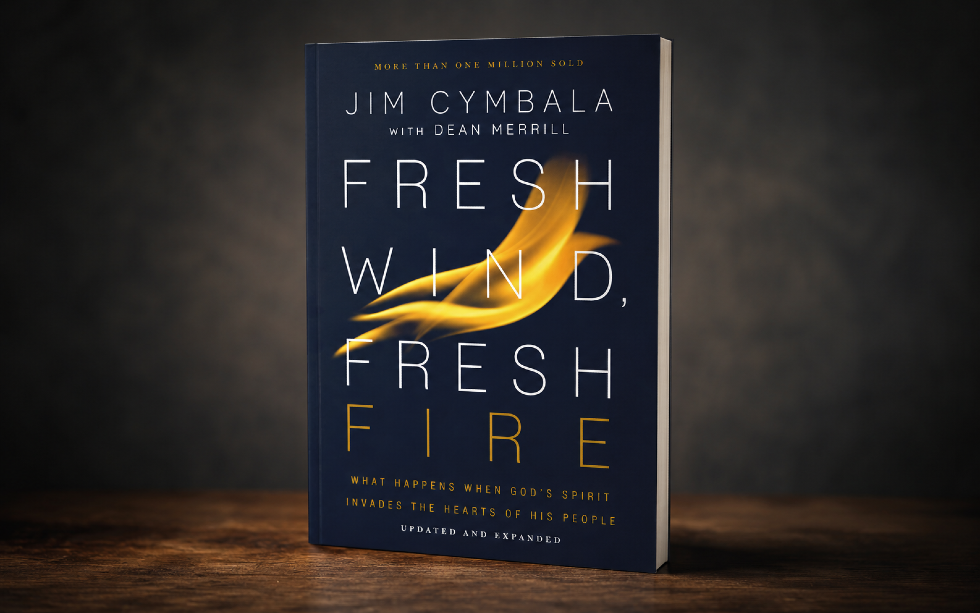
One of the most formative books of my teenage years was Jim Cymbala's Fresh Wind, Fresh Fire. Using stories from his church congregation, the Brooklyn Tabernacle, Cymbala argues that true spiritual transformation comes not through programs or human effort, but through wholehearted seeking of God.
A Troubling Thought
As I rescanned Fresh Wind, Fresh Fire in preparation for this post, I noticed several quotes I'd underlined:
- “The more we pray, the more we sense our need to pray. The more we sense a need to pray, the more we want to pray.”[1]
- “Jesus is not terribly impressed with religious commercialism. He is concerned not only whether we're doing God's work, but also how and why we're doing.”[2]
- “Trouble is one of God's great servants because it reminds us how much we continually need the Lord.”[3]
One of the lines that continues to resonate to this day is found on page 23, where Cymbala writes,
I despaired at the thought that my life might slip by without seeing God show himself mightily on our behalf.[4]
Looking back, I can see there are ways I prayed that quote too selfishly. Part of me wanted to see God work in my life out of a sense of ego. I wanted to see him bless my ministry, my goals, my agenda.
Now I would look at this quote a little differently. I do not have this obsessive urge that God would bless my plans, but I do have a persistent desire that he would show his power in the lives of me, my family, and my friends.
That he would place us in situations that force us to depend more on him. That my kids would grow up and know God is real, not just because they believe in him conceptionally, but because they have encountered him experientially.
The Bent Toward Self-Reliance
One of my favorite YouTube channels is Mr. Self Reliance, a guy who got tired of corporate life in Toronto and moved north of the city to the woods. While I enjoy watching him build log cabins and live off the land, I’m also aware that his channel's title is misleading.
No one is truly self-reliant. But each day, I'm consciously aware of my natural bent towards this self-reliant behavior.
- Why do I need to pray if I can just fix my problems myself?
- Why ask for God's blessing on my career if I can just work harder and make more money?
- Why seek God's blessing on my family if I can just take them on a vacation?
- Why do I need God's blessing on my marriage if I am kind to my wife?
It's the wisdom from authors like Jim Cymbala that reminds me to do everything I can to live in a daily rhythm of God-reliance.
One of the quotes from Cymbala that I dislike (even if I can't deny its accuracy) is when he notes, “Prayer cannot truly be taught by principles and seminars and symposiums. It has to be born out of a whole environment of felt need. If I say, 'I ought to pray,' I will soon run out of motivation and quit; the flesh is too strong. I have to be driven to pray."[5]
Here's why that quote creates some conflict in me.
I feel like our love for God is so strong that it should compel us to seek him, regardless of our circumstances. But I can't deny the reality that the environment we’re in plays a greater role than most of us would like. That's why, in an era of comfort and abundance, it's important that we, as Christians, place ourselves in positions where our reliance on God can grow.
One practical way to do this is to shift the way we pray. Less praying about comfort enhancement and more about character transformation. Less obsessing over God to increase our wealth, and more desiring him to increase our dependence. Fewer requests that God would make everything smooth for our kids, and more requests that he would lead them into situations that would show them their need for him.
Without God, no matter how good life is, we have every reason to despair. With him, no matter how bad life is, we have everything we need.
[1] Jim Cymbala, Fresh Wind, Fresh Fire: What Happens When God’s Spirit Invades the Hearts of His People (Grand Rapids, MI: Zondervan, 2001), 50.
[3] Ibid, 57-58.
[4] Ibid, 23.
[5] Ibid, 49.