When Reason Goes Mad and Understanding is a Burden
Human understanding has limits, and endless striving for knowledge and reason can lead to despair. True peace comes from trusting in God, who created and knows the whole of the universe and holds us in his hands.


I love to read. Actually, I love books; I’m a bibliophile. Perhaps a more accurate description is that I love to buy books I hope to read one day! The world is full of problems and solutions, and gaining knowledge across a broad range of topics seems prudent. More than prudent, it seems necessary.
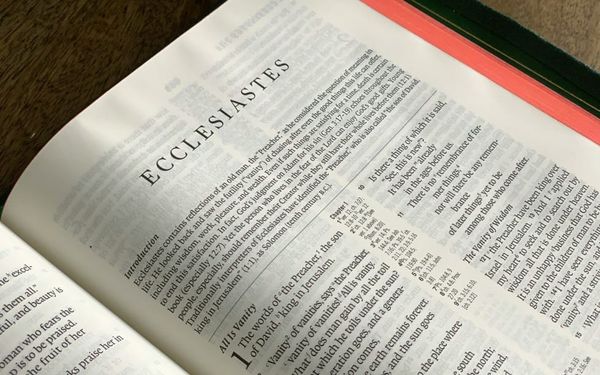
I crave wisdom and knowledge as a means of understanding the world and protecting myself from it. But no matter how much I learn, I immediately expose some lack of knowledge and find myself on an endless hamster wheel of striving. In Ecclesiastes chapter 1, Solomon says, “The eye never has enough of seeing, nor the ear its fill of hearing.” I find this to be true in my own heart.
But how can the search for wisdom be wrong? Doesn’t the book of Proverbs exhort us to seek Wisdom with everything we have? The answer is yes…and no. Often, trying to fit the world into tidy boxes in our own minds leads not to peace and understanding, but to anxiety and inner turmoil.
The Sorrow of Wisdom
Can something good, like wisdom, also be harmful? Solomon describes his own search for wisdom in Ecclesiastes 1:12-18:
“I, the Teacher, was king over Israel in Jerusalem. I applied my mind to study and to explore by wisdom all that is done under the heavens. What a heavy burden God has laid on mankind! I have seen all the things that are done under the sun; all of them are meaningless, a chasing after the wind. What is crooked cannot be straightened; what is lacking cannot be counted. I said to myself, “Look, I have increased in wisdom more than anyone who has ruled over Jerusalem before me; I have experienced much of wisdom and knowledge.” Then I applied myself to the understanding of wisdom, and also of madness and folly, but I learned that this, too, is a chasing after the wind. For with much wisdom comes much sorrow; the more knowledge, the more grief.”
Solomon was said to be the wisest man to ever live. His kingdom was wealthy and powerful. He built the Temple of the Lord, palaces, and many projects; he collected writings from around the world, and far-away nations came to witness the great king, revel in the wealth and majesty of what he had built, and bask in his wisdom. Yet this is the man who later writes that the wisdom of all that is done under the heavens is a heavy burden God laid on mankind. “For with much wisdom comes much sorrow; the more knowledge, the more grief.”
How could a man of such learning come to such despair and sorrow? How could a man who set out to “explore, by wisdom, all that is done under the heavens,” conclude that it, too, is a chasing after the wind?
The Existential Void
Viktor Frankl, a survivor of the concentration camps of WWII and founder of the school of psychotherapy called logotherapy, recounted his time in the camps in his now world-famous book, Man’s Search for Meaning. In the book, he describes a phenomenon he calls “Sunday Neurosis," in which a kind of existential vacuum sets in once the busyness of life is hushed. He writes:
“‘Sunday Neurosis,’ that kind of depression which afflicts people who become aware of the lack of content in their lives when the rush of the busy week is over and the void within themselves becomes manifest.”
King Solomon carved an empire out of the ancient world and amassed vast resources, monuments, wealth, and knowledge, but the moment his activity ceased, and he evaluated the sum of human achievements in the light of cold rationality, the existential void became manifest. He experienced the worst case of “Sunday Neurosis” a man can experience.
After the knowledge was learned, the palaces built, the legacy established…what was left? Perhaps he felt like it had all been a waste of time. One day he would die, and the world would spin on without him. What had his wisdom achieved for him in a world where nothing was ever new, and the end of all things remained the same regardless of his worldly accolades? Without a deeper meaning and purpose, even wisdom was merely vanity.
Poets and Microscopes
One of my all-time favorite writers is G. K. Chesterton. In two different works, Chesterton brilliantly diagnoses reason's fatal flaw and why it leads to madness. He addresses the mistaken idea that imagination, especially mystical imagination, is somehow dangerous to a man’s mental balance; that Poets are commonly spoken of as psychologically unreliable. He argues against this idea. In his book, Orthodoxy, he says:
“The Madman is not the one who has lost his reason. The Madman is the man who has lost everything except his reason…Poets do not go mad; but chess players do. Mathematicians go mad, and cashiers; but creative artists very seldom…Poetry is sane because it floats easily in an infinite sea; reason seeks to cross the infinite sea, and so make it finite. The result is mental exhaustion…The poet only asks to get his head into the heavens. It is the logician who seeks to get the heavens into his head. And it is his head that splits.”
So it is the purely logical man who seeks to encircle the whole of the universe inside his own understanding and, in doing so, is driven to exhaustion, despair, and ultimately madness. Solomon was acting as the ultimate logician by trying to accumulate the workings of an entire world, broken, mysterious, and expansive as it is, into his human-sized system of understanding. Operating on purely human reason instead of God’s sovereignty, he tried to stuff the heavens into his head, and his head was splitting.
Chesterton offers another beautiful illustration I find particularly helpful on knowledge and wisdom. In his earlier book, Heretics, Chesterton says this, in a way only he could:
“The globe-trotter lives in a smaller world than the peasant…the man in the saloon steamer (steam ship) has seen all the races of men, and he is thinking of the things that divide men—diet, dress, decorum, rings in the nose as in Africa, or in the ears as in Europe, blue paint among the ancients, or red paint among the modern Britons. The man in the cabbage field has seen nothing at all; but he is thinking of the things that unite men—hunger and babies, and the beauty of women, and the promise or menace of the sky…The telescope makes the world smaller; it is only the microscope that makes it larger.”
A telescope shrinks the incomprehensible and far off down to a manageable size. By looking through an intellectual telescope, Solomon reduced the world’s myriad complexity into a repetitive system of simple gears and levers he could understand. By looking at the forest as a whole, he thought he understood it but had lost sight of the trees. To return to the earlier metaphor, he tried stuffing the heavens into his head.
Godly Wisdom through Trust in God
In contrast to a telescope, a microscope takes something tiny and unseen and enlarges it so that a tiny piece of the world becomes to a man as large as the whole world. Had Solomon looked at the world through a microscope instead of a telescope, he would have seen only a tiny fraction of the whole, but that fraction would have expanded in his sight to reveal the true immensity, complexity, and beauty of the world God made.
Reading through the book of Ecclesiastes can feel depressing. Is everything really meaningless? Is it really vanity to seek wisdom or use our reason? Without God, all is truly meaningless, but these ancient words are not meant to drive us to despair; rather, they are meant to lead us to surrender to Him, who ultimately has the breadth and majesty of all the heavens in His head.
We can’t know everything, even if we’d like to. We’ll never be as wise as God himself, and we're not meant to be. We’re designed to live in complete childlike faith in the all-wise God who loves us. He created the world and knows every last inch of it, inside and out.
It’s easy to fall into the trap of trusting in our own understanding; our own wisdom. We strive for more knowledge in an attempt to get the heavens into our heads. Instead, God invites us to trust Him and get our heads into the heavens to experience a small part of the glory of God, His creation, and His plan for us. True peace doesn’t come from solving every mystery of the universe, but rather from trusting in the God who knows all things.
I’m reminded of a verse I memorized as a small child, Proverbs 3:5-6: “Trust in the Lord with all your heart and lean not on your own understanding; in all your ways submit to Him, and he will make your paths straight.”
Seek wisdom. Gain knowledge. Desire understanding. But remember that God’s ways are higher than our ways. Trust in Him.